


circuit-maintenance-parser is a Python library that parses circuit maintenance notifications from Network Service Providers (NSPs), converting heterogeneous formats to a well-defined structured format.
Full documentation for this library can be found over on the Circuit-Maintenance-Parser Docs website:
- User Guide - Overview, Using the Library, Getting Started.
- Administrator Guide - How to Install, Configure, Upgrade, or Uninstall the Library.
- Developer Guide - Extending the Library, Code Reference, Contribution Guide.
- Release Notes / Changelog.
- Frequently Asked Questions.
Every network depends on external circuits provided by NSPs who interconnect them to the Internet, to office branches or to external service providers such as Public Clouds.
Obviously, these services occasionally require operation windows to upgrade or to fix related issues, and usually, they happen in the form of circuit maintenance periods. NSPs generally notify customers of these upcoming events so that customers can take actions to minimize the impact on the regular usage of the related circuits.
The challenge faced by many customers is that almost every NSP defines its own maintenance notification format, even though in the end the relevant information is mostly the same across NSPs. This library is built to parse notification formats from several providers and to return always the same object struct which will make it easier to process them afterwards.
The format of this output follows the BCOP defined during a NANOG meeting that aimed to promote the usage of the iCalendar format. Indeed, if the NSP is using the proposed iCalendar format, the parser is straightforward and there is no need to define custom logic, but this library enables supporting other providers that are not using this proposed practice, getting the same outcome.
You can leverage this library in your automation framework to process circuit maintenance notifications and use the standardized Maintenance model to handle your received circuit maintenance notifications in a simple way. Every Maintenance object contains the following attributes:
- provider: identifies the provider of the service that is the subject of the maintenance notification.
- account: identifies an account associated with the service that is the subject of the maintenance notification.
- maintenance_id: contains text that uniquely identifies (at least within the context of a specific provider) the maintenance that is the subject of the notification.
- circuits: list of circuits affected by the maintenance notification and their specific impact. Note that in a maintenance canceled or completed notification, some providers omit the circuit list, so this may be blank for maintenance notifications with a status of CANCELLED or COMPLETED.
- start: timestamp that defines the starting date/time of the maintenance in GMT.
- end: timestamp that defines the ending date/time of the maintenance in GMT.
- stamp: timestamp that defines the update date/time of the maintenance in GMT.
- organizer: defines the contact information included in the original notification.
- status: defines the overall status or confirmation for the maintenance.¹
- summary: human-readable details about this maintenance notification. May be an empty string.
- sequence: a sequence number for notifications involving this maintenance window. In practice, this is generally redundant with the stamp field and will be defaulted to
1for most non-iCalendar parsed notifications.² - uid: a unique (?) identifier for a thread of related notifications. In practice, this is generally redundant with the maintenance_id field and will be defaulted to
0for most non-iCalendar parsed notifications.
Please, refer to the BCOP to more details about the standardized meaning of these attributes.
¹ Per the BCOP, the status (X-MAINTNOTE_STATUS) is an optional field in iCalendar notifications. However, a Maintenance object will always contain a status value; in the case where an iCalendar notification omits this field, the status will be set to "NO-CHANGE", and it's up to the consumer of this library to determine how to appropriately handle this case. Parsers of other notification formats are responsible for setting an appropriate value for this field based on the notification contents, and may or may not include "NO-CHANGE" as one of the possible reported values.
² Per the BCOP, the sequence is a mandatory field in iCalendar notifications. However, some NSPs have been seen to send notifications which, while otherwise consistent with the BCOP, omit the SEQUENCE field; in such cases, this library will report a sequence number of -1.
- We instantiate a
Provider, directly or via theinit_providermethod, that depending on the selected type will return the corresponding instance. - Get an instance of the
NotificationDataclass. This instance groups togetherDataPartswhich each contain some content and a specific type (that will match a specificParser). For example, aNotificationDatamight describe a received email message, withDataPartscorresponding to the subject line and body of the email. There are factory methods to initialize aNotificationDatadescribing a single chunk of binary data, as well as others to initialize one directly from a raw email message oremail.message.EmailMessageinstance. - Each
Provideruses one or moreProcessorsthat will be used to buildMaintenanceswhen theProvider.get_maintenances(data)method is called. - Each
Processorclass uses one or moreParsersto process each type of data that it handles. It can have custom logic to combine the parsed data from multipleParsersto create the finalMaintenanceobject. - Each
Parserclass supports one or a set of related data types, and implements theParser.parse()method used to retrieve aDictwith the relevant keys/values.
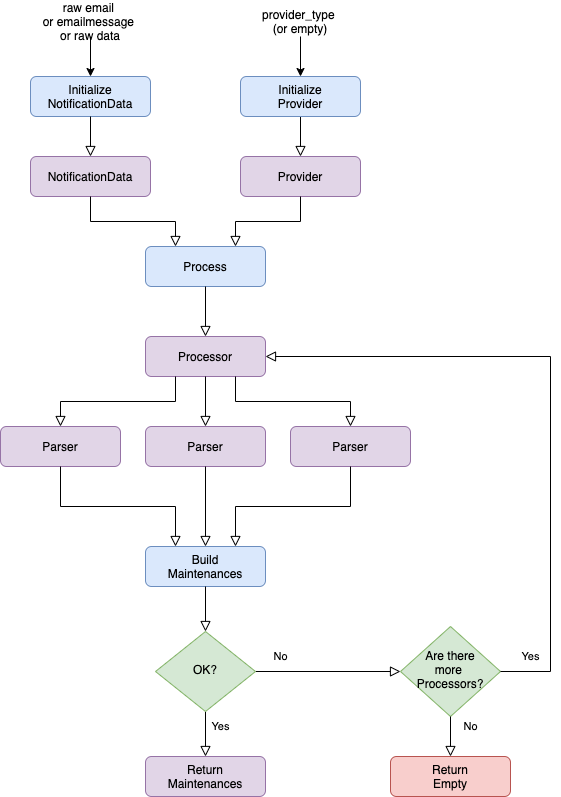
By default, there is a GenericProvider that supports a SimpleProcessor using the standard ICal Parser, being the easiest path to start using the library in case the provider uses the reference iCalendar standard.
- Arelion (previously Telia)
- EuNetworks
- EXA (formerly GTT) (*)
- NTT
- PacketFabric
- PCCW
- Telstra (*)
- Apple
- ATT
- AWS
- AquaComms
- BSO
- Cogent
- Colt
- Crown Castle Fiber
- Equinix
- EXA (formerly GTT) (*)
- HGC
- Global Cloud Xchange
- Lumen
- Megaport
- Momentum
- Netflix (AS2906 only)
- PCCW
- Seaborn
- Sparkle
- Tata
- Telstra (*)
- Turkcell
- Verizon
- Windstream
- Zayo
(*) Providers in both lists, with BCOP standard and nonstandard parsers.
Note: Because these providers do not support the BCOP standard natively, maybe there are some gaps on the implemented parser that will be refined with new test cases. We encourage you to report related issues!
The library supports an optional parser option leveraging Large Language Models (LLM) to provide best-effort parsing when the specific parsers have not been successful.
Warning: Some of these integrations, such as OpenAI, require of extras installations parameters. Check the extras section
When the appropriate environment variable(s) are set (see below), these LLM parsers are automatically appended after all existing processors for each defined Provider.
These integrations may involve some costs for API usage. Use it carefully! As an order of magnitude, a parsing of an email with OpenAI GPT gpt-3.5-turbo model costs $0.004.
These are the currently supported LLM integrations:
-
PARSER_LLM_QUESTION_STR(Optional), question to overwrite the default one. Change it carefully. It has precedence overPARSER_LLM_QUESTION_FILEPATH -
PARSER_LLM_QUESTION_FILEPATH(Optional), a path to a file that contains a question to overwrite the default one. -
OpenAI, these are the supported ENVs:
PARSER_OPENAI_API_KEY(Required): OpenAI API Key.PARSER_OPENAI_MODEL(Optional): The LLM model to use, defaults to "gpt-3.5-turbo".
Each Maintenance comes with a metadata attribute to provide information about the provider used and the process and parsers used in the successful parsing of the maintenance.
This information is relevant to validate the actual content of the Maintenance because it may be generated using an LLM-powered parser which means that the confidence level is lower than using a pre-defined parser. You can check the Metadata.generate_by_llm boolean to check it.
The library is available as a Python package in pypi and can be installed with pip:
pip install circuit-maintenance-parser
pip install circuit-maintenance-parser[openai]
Some providers may attach a spreadsheet in their circuit maintenance notifications. Support for this is provided by installing the optional xlsx package.
pip install circuit-maintenance-parser[xlsx]
The library requires two things:
- The
notificationdata: this is the data that the library will check to extract the maintenance notifications. It can be simple (only one data type and content, such as an iCalendar notification) or more complex (with multiple data parts of different types, such as from an email). - The
provideridentifier: used to select the properProviderwhich contains theprocessorlogic to take the properParsersand use the data that they extract. By default, theGenericProvider(used when no other provider type is defined) will support parsing ofiCalendarnotifications using the recommended format.
The first step is to define the Provider that we will use to parse the notifications. As commented, there is a GenericProvider that implements the gold standard format and can be reused for any notification matching the expectations.
from circuit_maintenance_parser import init_provider

generic_provider = init_provider()

type(generic_provider)
<class 'circuit_maintenance_parser.provider.GenericProvider'>
However, usually some Providers don't fully implement the standard and maybe some information is missing, for example the organizer email or maybe a custom logic to combine information is required, so we allow custom Providers:
ntt_provider = init_provider("ntt")

type(ntt_provider)
<class 'circuit_maintenance_parser.provider.NTT'>
Once we have the Provider ready, we need to initialize the data to process, we call it NotificationData and can be initialized from a simple content and type or from more complex structures, such as an email.
from circuit_maintenance_parser import NotificationData

raw_data = b"""BEGIN:VCALENDAR
VERSION:2.0
PRODID:-//Maint Note//https://github.com/maint-notification//
BEGIN:VEVENT
SUMMARY:Maint Note Example
DTSTART;VALUE=DATE-TIME:20151010T080000Z
DTEND;VALUE=DATE-TIME:20151010T100000Z
DTSTAMP;VALUE=DATE-TIME:20151010T001000Z
UID:42
SEQUENCE:1
X-MAINTNOTE-PROVIDER:example.com
X-MAINTNOTE-ACCOUNT:137.035999173
X-MAINTNOTE-MAINTENANCE-ID:WorkOrder-31415
X-MAINTNOTE-IMPACT:OUTAGE
X-MAINTNOTE-OBJECT-ID;X-MAINTNOTE-OBJECT-IMPACT=NO-IMPACT:acme-widgets-as-a-service
X-MAINTNOTE-OBJECT-ID;X-MAINTNOTE-OBJECT-IMPACT=OUTAGE:acme-widgets-as-a-service-2
X-MAINTNOTE-STATUS:TENTATIVE
ORGANIZER;CN="Example NOC":mailto:noone@example.com
END:VEVENT
END:VCALENDAR
"""

data_to_process = NotificationData.init_from_raw("ical", raw_data)

type(data_to_process)
<class 'circuit_maintenance_parser.data.NotificationData'>
Finally, with we retrieve the maintenances (it is a List because a notification can contain multiple maintenances) from the data calling the get_maintenances method from the Provider instance:
maintenances = generic_provider.get_maintenances(data_to_process)

print(maintenances[0].to_json())
{
"account": "137.035999173",
"circuits": [
{
"circuit_id": "acme-widgets-as-a-service",
"impact": "NO-IMPACT"
},
{
"circuit_id": "acme-widgets-as-a-service-2",
"impact": "OUTAGE"
}
],
"end": 1444471200,
"maintenance_id": "WorkOrder-31415",
"organizer": "mailto:noone@example.com",
"provider": "example.com",
"sequence": 1,
"stamp": 1444435800,
"start": 1444464000,
"status": "TENTATIVE",
"summary": "Maint Note Example",
"uid": "42"
}
Notice that, either with the GenericProvider or NTT provider, we get the same result from the same data, because they are using exactly the same Processor and Parser. The only difference is that NTT notifications come without organizer and provider in the notification, and this info is fulfilled with some default values for the Provider, but in this case, the original notification contains all the necessary information, so the defaults are not used.
ntt_maintenances = ntt_provider.get_maintenances(data_to_process)
assert maintenances_ntt == maintenances
Every maintenance contains the metadata attribute to understand how has been parsed:
print(maintenances[0].metadata)
provider='genericprovider' processor="SimpleProcessor" parsers=["ICal"], generated_by_llm=FalseThere is also a cli entry point circuit-maintenance-parser which offers easy access to the library using a few arguments:
data-file: file storing the notification.data-type:ical,htmloremail, depending on the data type.provider-type: to choose the rightProvider. If empty, theGenericProvideris used.
circuit-maintenance-parser --data-file "/tmp/___ZAYO TTN-00000000 Planned MAINTENANCE NOTIFICATION___.eml" --data-type email --provider-type zayo
Circuit Maintenance Notification #0
{
  "account": "some account",
  "circuits": [
    {
      "circuit_id": "/OGYX/000000/ /ZYO /",
      "impact": "OUTAGE"
    }
  ],
  "end": 1601035200,
  "maintenance_id": "TTN-00000000",
  "organizer": "mr@zayo.com",
  "provider": "zayo",
  "sequence": 1,
  "stamp": 1599436800,
  "start": 1601017200,
  "status": "CONFIRMED",
  "summary": "Zayo will implement planned maintenance to troubleshoot and restore degraded span",
  "uid": "0"
}Pull requests are welcomed and automatically built and tested through GitHub Actions.
The project is following Network to Code software development guidelines and is leveraging:
- Ruff for Python linting and formatting.
- Pylint for additional static analysis.
- Unit and integration tests to ensure the library is working properly.
For more details, see the Contributing Guide and Development Environment Guide.
For any questions or comments, please check the FAQ first. Feel free to also swing by the Network to Code Slack (channel #networktocode), sign up here if you don't have an account.
This library uses a Basic World Cities Database by Pareto Software, LLC, the owner of Simplemaps.com: The Provider offers a Basic World Cities Database free of charge. This database is licensed under the Creative Commons Attribution 4.0 license as described at: https://creativecommons.org/licenses/by/4.0/.